Account


Wine Glass Place Settings: How to Set the Table for a Dinner Party
Start exploring

Host your next dinner party with finesse by knowing exactly where the wine glasses belong. Between the cutlery, the main and side plates, the water glasses, and the napkins, laying a table can quickly get confusing, and serving wine adds a few more glasses to fit. In this guide, we walk you through where each one goes, and why.
Quick guide: where wine glasses go
- Position: Top right of the setting, above the knife
- Water glass: Directly above the knife
- Wine glasses: To the right of the water glass, in order of use
- Sparkling glass: Just behind the wine glasses
- Relaxed supper: One water glass and one wine glass per guest
Jump to a section
Where Do Wine Glasses Go on a Dinner Table?
Wine glasses go on the right-hand side of each place setting, above the knives. Most people are right-handed, so glasses on the right are easy to reach without stretching across the plate or a neighbour. Etiquette expert William Hanson of The English Manner, the London etiquette and protocol institute, advises setting the glasses above the knives and spoons, with the main glass directly above the main-course knife.
Jargon explained: place setting
A place setting is everything laid out for one guest: the plate, cutlery, glasses and napkin.
Hospitality schools teach the same layout. EHL Hospitality Business School recommends placing the water glass directly above the knife, with any wine glasses set to its right.
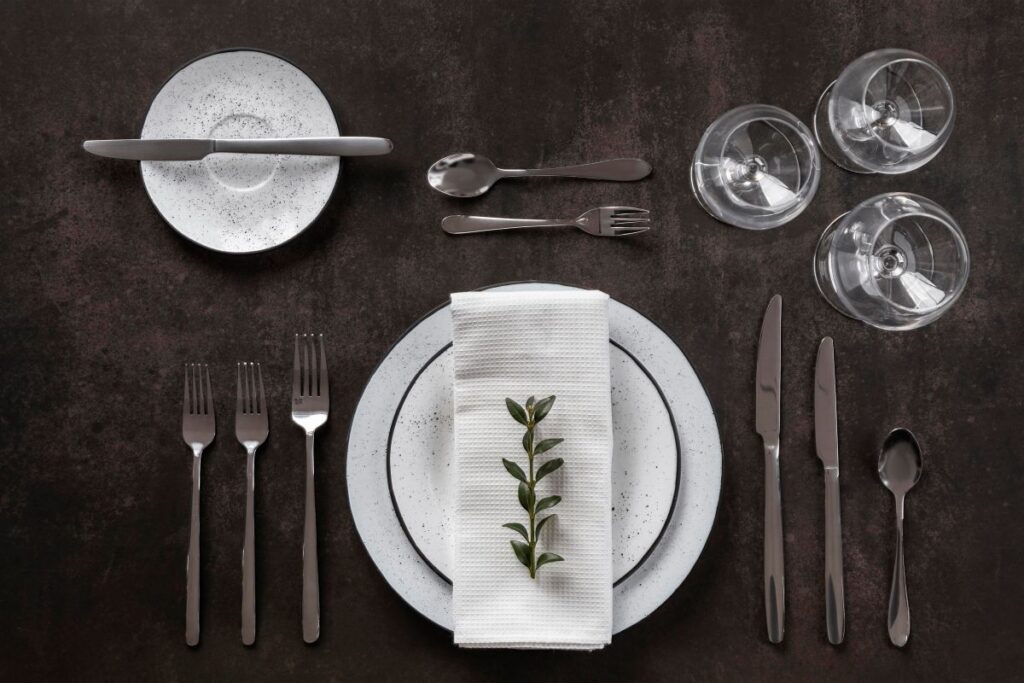
The basic layout, piece by piece
Start with the plate and build outwards:
- Plate: In the centre, about 2.5cm (one inch) in from the edge of the table
- Forks: On the left of the plate, in the order they will be used
- Knives and spoons: On the right of the plate
- Water glass: Directly above the knife
- Wine glasses: To the right of the water glass
- Napkin: To the left of the forks
Give each guest enough room. Hospitality course material from India’s INFLIBNET Centre recommends about 60cm of width for each place setting, with plates set roughly an inch in from the table edge. That space lets everyone reach their glasses without bumping elbows.
Good to know: keep the line neat
Space the glasses evenly and line up their bases. EHL even suggests using a ruler for a formal table. A tidy row of glasses makes a simple table look polished.
What Order Do Wine Glasses Go In?
Place wine glasses in the order they will be used, working from right to left. The glass for the first wine sits on the outside, and each later glass sits closer to the water glass. It follows the same logic as cutlery, which Debrett’s explains is used from the outside in.
At a typical dinner party, guests pour white wine before red. Wine Spectator recommends moving from lighter wines to heavier ones, and from dry wines to sweet ones. So the white wine glass sits furthest right, with the red wine glass between it and the water glass. Need ideas for which bottles to pour? Our white wine guide and red wine guide cover styles and food pairings for each course.
Here is how each glass fits into a full setting:
| Glass | Where it sits | When it is used | Shape to look for |
|---|---|---|---|
| Water glass | Directly above the knife | Throughout the meal | A large goblet or a low tumbler |
| White wine glass | Furthest to the right, slightly lower | Starter or fish course | Taller with a narrower bowl |
| Red wine glass | Between the white wine glass and the water glass | Main course | Bigger with a rounder bowl |
| Sparkling wine glass | Just behind the white wine glass, forming a triangle | Welcome drink or a toast | A flute or a tulip-shaped glass |
| Dessert wine glass | Usually brought to the table with pudding | Dessert course | A smaller glass for a smaller pour |
The glass shapes for red and white follow Debrett’s simple rule: bigger, rounder glasses for red, and taller, thinner glasses for white. The positions follow the layout taught at EHL, and hospitality course material from INFLIBNET sets them in the same order: water, red, white, then a sparkling glass. For more on choosing shapes and sizes, see our complete guide to wine glasses.
Jargon explained: flute
A flute is a tall, slim glass for sparkling wine. Its narrow shape helps the bubbles last longer. Our sparkling wine guide covers the styles you might pour into one.
Jargon explained: dessert wine
Dessert wine is a sweet wine served with pudding or cheese. It is rich, so it is poured in smaller amounts than a dry wine.
Should glasses sit in a line or a triangle?
Both layouts work well, but it depends on how many glasses you have. EHL teaches a small triangle when a sparkling glass joins the wine glasses, while a simple line suits fewer glasses. These are the guidelines:
- Two or three glasses: A gentle diagonal line, sloping down to the right, looks neat and keeps every glass in reach
- Four or more glasses: A small triangle or cluster saves space and stops the row from reaching too far across the table
How Many Glasses Do You Need for a Dinner Party?
Most dinner parties need two glasses per guest: one for water and one for wine. Add another glass only for each extra wine you plan to serve.
The English Manner advises setting only the glasses you will use, so if you’re not pouring white wine, leave the white wine glass off. The Emily Post Institute adds that a sparkling glass earns its place if you plan a toast. For a relaxed meal, one wine glass sits just to the right of the water glass.
| Style of dinner | Glasses per guest | What to set out |
|---|---|---|
| Relaxed kitchen supper | 2 | A water glass and one all-purpose wine glass |
| Three-course dinner party | 3 to 4 | Water, white and red, plus a sparkling glass for a welcome drink |
| Formal or celebration dinner | 4 to 5 | Water, sparkling, white and red, with a dessert wine glass brought out for pudding |
Jargon explained: all-purpose wine glass
An all-purpose (or universal) wine glass has a medium-sized bowl that suits red, white and sparkling wine reasonably well. It is a smart choice for relaxed dinners and smaller kitchens.
Keep a few spare glasses to hand. In its guide to entertaining at home, Debrett’s advises hosts to over-cater on glasses, because running short mid-evening looks disorganised. Planning a dedicated tasting evening instead? Our guide on how to host a wine tasting party at home covers the glasses you will need.
How Should You Serve Wine Once the Table Is Set?
Serve wine from light to heavy and from dry to sweet, at the right temperature, and pour no more than a third of the glass. Those three habits make every bottle taste its best, from a crisp white with the starter to a sweet wine with pudding.
What temperature should each wine be?
Temperature changes how wine tastes. Serve it too warm, and it can feel heavy; too cold, and the flavours become muted. These are the ideal serving temperatures:
- Sparkling wine: 9°C
- Rosé wine: 11°C
- White wine: 12°C
- Red wine: 17°C
For a dinner party, serve each wine type carefully. Chill whites and sparkling wine in the fridge for a few hours, then take whites out about 20 minutes before pouring. Most reds benefit from a short spell in a cool spot rather than a warm kitchen. Some fuller reds also open up in a decanter, which our guide to carafes and decanters explains.
How much wine should you pour?
Fill a wine glass no more than a third full. Wine Spectator explains that the space left in the glass lets guests swirl the wine without spilling and catch its aromas.
For scale, UK venues must serve still wine by the glass in 125ml or 175ml measures, according to GOV.UK. A standard 75cl bottle holds six 125ml servings, so one bottle per course for every three or four guests is a good rule of thumb. Our guide to how many glasses are in a bottle of wine breaks the numbers down further.
How should guests hold a wine glass?
Hold a wine glass by the stem or the base, not the bowl. Decanter explains that warmth from your hand can heat the wine, which affects chilled sparkling and white wines most. Holding the stem also keeps fingerprints off the bowl and makes swirling easier.
Jargon explained: bowl and stem
The bowl is the rounded part of a wine glass that holds the wine. The stem is the slim part between the bowl and the base.
What Are the Most Common Wine Glass Mistakes?
The most common mistakes are crowding the table with too many glasses and filling them too high. Here are the slip-ups to watch for, and the easy fix for each:
- Too many glasses: Set out only the glasses you need. EHL advises against an overcrowded table, and you can always bring out a spare glass later.
- Glasses in the wrong order: Put the first wine on the far right, so guests work inwards just as they do with cutlery.
- Overfilled glasses: Pour a third full at most and top up as the evening goes on.
- No water on the table: Fill water glasses just before guests sit down, as EHL suggests, and keep a jug nearby.
- Dusty or cloudy glasses: Give each glass a final polish with a clean, lint-free cloth. The English Manner suggests setting glasses last, closer to the meal, so they stay clean and are not knocked over while you lay the rest of the table.
Find Your Next Dinner Party Wine
Once the table is laid, the best part is choosing what to pour. Come and taste with us at Bolney Wine Estate in West Sussex, where vines have grown since 1972, and discover a few new favourites to share with your guests.
Frequently Asked Questions
Which side does the wine glass go on?
The wine glass goes on the right-hand side of the place setting, above the knives. Placing it on the right makes it easy for most guests to reach.
Does the water glass go to the left or right of the wine glasses?
The water glass goes to the left of the wine glasses, directly above the knife. It sits closest to the plate because guests use it throughout the meal.
Can you use the same glass for red and white wine?
Yes. An all-purpose wine glass works well for red, white and sparkling wine at a relaxed dinner party. Offer a fresh glass or a quick rinse with water when you switch from one wine to another.
Should wine glasses be on the table before guests arrive?
Yes. Lay the table with water and wine glasses before guests arrive. You usually bring out a dessert wine glass with pudding instead.
How full should a wine glass be at a dinner party?
A wine glass should be no more than a third full. The space above the wine lets guests swirl it and enjoy its aromas without spilling.
Sources
- EHL Hospitality Business School: Master the basics of table setting: Water glass position, glass order, triangle layout, filling water glasses just before guests sit down, spacing and avoiding overcrowding
- INFLIBNET Centre (UGC e-text): Laying a table: Place setting width, plate distance from the table edge and the order of glasses
- The English Manner (William Hanson): Five simple steps to set the dining table: Glasses above the knives, setting only the glasses you need and laying glasses last
- Emily Post Institute: Etiquette today, table setting: Setting only the glasses you need, plus a sparkling glass for a toast
- Debrett’s: A practical guide to table manners: Using cutlery from the outside in and red and white glass shapes
- Debrett’s: Guide to entertaining at home: Over-catering on glasses and laying the table in advance
- Wine Spectator: Wines should be sampled from whites to reds, right?: Serving order from light to heavy and dry to sweet
- Wine Spectator: How much wine should I pour into a wineglass?: Filling glasses no more than a third full
- Decanter: How to hold a wine glass: Holding the glass by the stem and why hand warmth affects chilled wines
- Decanter: At what temperature should I serve wine?: Serving temperatures for sparkling, rosé, white and red wine
- GOV.UK: Weights and measures, specified quantities: 125ml and 175ml measures for still wine by the glass