Account






Cork Or Screw Cap? Which Is Better For Wine
Start exploring

Cork or screw cap is one of the most common questions in wine, and one of the most misread. The closure is often taken as a sign of quality, when it is really a technical decision the winemaker has made about the wine inside.
Neither closure is better than the other. Each one suits a different kind of wine. The type of wine closure affects four things: the small chance of a faulty bottle, how well the wine ages, how you store it, and how easily you can reseal it.
If you are after the quick answers, start here:
- Screw caps (or twist off): Keep wine fresh and seal tightly. They cannot give wine the musty smell that cork sometimes causes, and they screw straight back on.
- Natural corks: Let in a tiny amount of air over the years, which suits wine meant to be kept for a long time. A small number of bottles pick up a musty smell.
- A screw cap does not mean cheap wine: New Zealand Winegrowers reports that around 90% of all New Zealand wine uses a screw cap, from cheap bottles to expensive ones.
- Sparkling wine is different: The pressure inside the bottle is why sparkling wine still uses a mushroom-shaped cork and a wire cage.
Jump to a section
- What is a cork closure?
- What is a screw cap closure?
- What is the difference between cork and screw cap?
- What is cork taint, and how do you spot it?
- Which wines use cork and which use screw cap?
- Why does sparkling wine almost always use a cork?
- Does a screw cap mean the wine is cheap?
- Should you think about the closure when buying wine?
- How to store and open each type
- Frequently asked questions
- Sources

What Is A Cork Closure?
A cork closure is a stopper made from the bark of the cork oak tree. The bark is stripped by hand, the tree keeps growing, and the cork is punched or moulded into stoppers.
Cork seals a bottle because it is springy. Push it into a bottle neck, and it keeps pressing outwards against the glass, which holds the seal in place for decades. It also lets a very small amount of air through over time, which is the quality winemakers care about most.
However, cork is slow to produce. The Union des Maisons de Champagne notes that a cork oak can be harvested from around 35 years old, and takes roughly 45 years to yield bark thick enough for a wine stopper.
Jargon explained: Natural cork
A natural cork is punched from one piece of bark. A technical or agglomerated cork is built from cork granules bonded together, usually with a disc of natural cork at the end that meets the wine.
We have covered the material itself in more depth already, so for the full picture, have a read of why cork is used for wine bottles.

What Is A Screw Cap Closure?
A screw cap (also known as a twist-off or a twist top) closure is an aluminium cap that twists onto a threaded bottle neck. The aluminium itself does not create the seal. A thin liner sits inside the cap and presses down onto the rim of the glass, and that liner is what keeps the wine sealed.
Jargon explained: Liner
The disc inside a screw cap that forms the seal. Different liner materials let through different amounts of oxygen, so the choice of liner changes how the wine develops.
Because the liner does the work, screw caps are not all the same. A winemaker picks the liner to match the wine, and The World of Fine Wine describes three main options:
- Tin and Saran liners: The tightest option, letting in very little oxygen. Common in Australia and New Zealand.
- Saranex liners: Slightly more permeable, and favoured by many European producers who want a little more oxygen reaching the wine.
- Variable liners: Newer caps designed to let in a small, controlled amount of air, closer to what a natural cork does.
Screw caps have been used on wine for far longer than most people assume. The Australian Wine Research Institute records that the wine screw cap was trademarked in 1959 by French manufacturer La Bouchage Mécanique under the name Stelcap-vin, licensed for Australian production in 1970, and renamed Stelvin in 1978.
What Is The Difference Between Cork And Screw Cap?
The main difference is how much oxygen each closure lets into the bottle over time. No closure is a perfect seal. Tiny amounts of air reach the wine, and that slow trickle changes how the wine tastes years later.
Jargon explained: Oxygen transfer rate
Often shortened to OTR, it measures how much oxygen a closure lets in over a set period. A lower rate keeps a wine fresher for longer. A higher rate ages it faster.
The most thorough test of this came from the Australian Wine Research Institute. In May 1999, it bottled a single Semillon under 14 different closures and tracked the wine for ten years. Bottles under screw cap stayed freshest and browned least. Several synthetic closures let in far more oxygen and the wines oxidised early. Natural corks fell in between, with noticeable variation from bottle to bottle.
| Factor | Natural cork | Screw cap |
|---|---|---|
| Cork taint risk | Small, and lower than it once was | Effectively removed |
| Bottle-to-bottle consistency | Varies, as natural materials do | Very consistent |
| Oxygen let in | Small and gradual | Set by the liner, from almost none upwards |
| Occasional issue | A dried-out cork on a very old bottle, letting in too much air | A struck-match smell that clears with air |
| Opening | Corkscrew needed | No tools |
| Resealing | Fiddly once the cork has swelled | Twist it back on |
| Storage position | On its side | Upright is fine |
The one quirk worth expecting from screw caps
Because the tightest liners let in so little air, a screw cap wine can sometimes smell faintly of struck match when first opened. Winemakers call it reduction, and The World of Fine Wine links it to the very low oxygen levels under tin-lined caps. A firm swirl or ten minutes in a decanter usually clears it.
What Is Cork Taint, And How Do You Spot It?
Cork taint is a fault caused by a compound called TCA. A wine affected by it smells musty, most often compared to damp cardboard, and the fruit flavours are flattened so the wine tastes dull.
A wine with this fault is described as corked. One myth is worth clearing up first: crumbs of cork floating in the wine are not a sign of “corked wine”. Those are harmless and easily removed.
Jargon explained: TCA
Short for 2,4,6-trichloroanisole. Decanter reports that researchers identified it as the main cause of cork taint in 1982. It affects a wine at just a few parts per trillion.
How to tell if a wine is corked
- Smell the wine, not the cork: The cork is not a reliable guide. Plenty of corks smell a little musty on bottles where the wine is perfectly fine.
- Check for a musty smell: Damp cardboard, a damp cellar or a wet dog are the descriptions people use most.
- Check for missing flavour: A mildly affected wine does not smell bad. It just tastes flat and watery, as though the fruit flavours have been turned down.
- Wait a few minutes and smell again: A normal wine changes and opens out with a little air. A corked wine stays the same.
That first sip is why waiters ask you to taste the wine before pouring for the table. Restaurants and wine shops expect the occasional faulty bottle and will usually replace it without any fuss.
How common is cork taint?
Published rates disagree, largely because people differ enormously in how easily they detect TCA. Wine Spectator reports that sensitivity varies widely depending on genetics and experience, which is why two people can share a bottle and only one of them notices anything wrong. It has nothing to do with how much you know about wine.
The figures currently quoted are:
- Cork industry estimates: Roughly 1% to 2% of bottles.
- Published research: A study in Food Quality and Preference estimates 2% to 5%.
- Trained tasting panels: Wine Spectator’s tastings of Californian wines found affected bottles falling from 9.5% in 2007 to 3.7% in 2012.
There is also no health concern. Decanter notes that cork taint is not considered harmful to health, and a microbiologist at Oregon State University told Wine Spectator that a tainted bottle may smell unpleasant but will not make you unwell.
Worth knowing: Screw cap bottles are not completely exempt
TCA can occasionally come from the winery rather than the cork. Decanter confirms a screw cap wine can technically show the same musty aromas, though it is far less common than with cork.
If some of the language here is new, our guide to wine terminology for beginners covers the words that come up most often.
Which Wines Use Cork And Which Use Screw Cap?
As a rule of thumb, wines meant to be drunk young and fresh tend towards screw cap, and wines meant to be kept for many years tend towards cork. Sparkling wine sits apart from both, for reasons of pressure rather than ageing.
Country matters as much as wine style. Research published in the International Journal of Wine Business Research cites 2020 figures showing screw cap use at 70.7% in Germany, 17.2% in France and 16.5% in Italy. A German Riesling and a French red of similar price will often carry different closures for reasons of local convention rather than quality.
| Type of wine | Usual closure | The reasoning |
|---|---|---|
| Fresh, aromatic white Sauvignon Blanc, Riesling, Pinot Grigio |
Screw cap | Aroma and freshness are the whole point of the style, and a tight liner protects both. These wines led the switch to screw cap in the early 2000s. |
| Fuller white for keeping Oak-aged Chardonnay, white Burgundy |
Both | Producers are split. Cork is traditional, and screw cap is increasingly used where the aim is a slower, steadier development. |
| Everyday red Most reds under about £15 |
Screw cap in New World, cork in Europe | These wines are usually opened within a year or two, so consistency matters more than long ageing. Regional convention decides the rest. |
| Red built to age Classed-growth Bordeaux, Barolo, fine Rioja |
Natural cork | Cork has the longest proven record over twenty years and more, and these regions have strong traditions around it. |
| Rosé | Both, with screw cap growing | Nearly all rosé is drunk young, so freshness matters more than slow development. |
| Sparkling wine Champagne, English sparkling, Prosecco Spumante |
Mushroom cork and wire cage | The bottle holds 5 to 6 bar of pressure. Very few closures can contain it. |
| Lightly sparkling wine Frizzante styles, Moscato |
Screw cap or crown cap | Far less pressure inside, so a standard cap holds the fizz without any trouble. |
The New World and Old World split is stark. New Zealand Winegrowers reports around 90% of New Zealand wine under screw cap, while France and Italy remain well under 20%.
Why Does Sparkling Wine Almost Always Use A Cork?
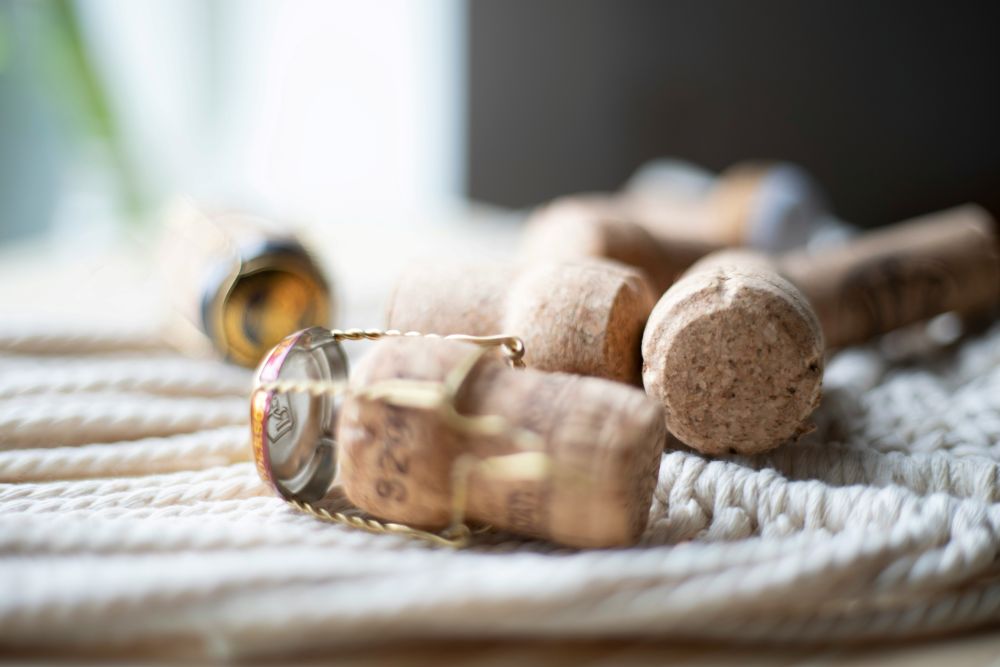
The reason is pressure. The Comité Champagne puts the pressure inside a Champagne bottle at 5 to 6 bar, around three times the pressure of a car tyre. Very few closures can hold that, which is why the mushroom cork and wire cage remain standard.
Jargon explained: Muselet
The wire cage over a sparkling wine cork. The name comes from the French museler, to muzzle. It holds the cork in place against the pressure until you are ready to open the bottle.
A sparkling wine cork is built differently from a still wine cork. The Union des Maisons de Champagne describes a body of agglomerated cork granules, topped at the wine end with two glued discs of clean natural cork, each 31mm across and 4mm thick, in a stopper no longer than 48mm. Only those two discs touch the wine.
The mushroom shape forms after bottling rather than before. The cork goes into the bottle as a straight cylinder, and the section inside the neck stays compressed while the exposed top expands outwards. That is why an old cork will not go back into the bottle it came from.
Why some sparkling wines have a beer-style metal cap
Traditional method sparkling wine spends its second fermentation and its long rest under a crown cap, the same closure found on a beer bottle. Research in the South African Journal of Oenology and Viticulture notes that crown caps are standard practice worldwide for this stage, that they were first used commercially in 1960, and that before then bottles were sealed with a cork held by a metal staple called an agrafe.
Jargon explained: Disgorgement
The stage where the crown cap comes off and the yeast sediment is removed, just before the mushroom cork goes in. Everything before that point happens under a metal cap.
Some producers skip the swap and sell the wine with the crown cap still in place. If sparkling wine production is new to you, our guide to sparkling wine is a good starting point.
Can sparkling wine come under screw cap?
Yes, within limits. Lightly sparkling frizzante styles are held at lower pressure and are often sealed with a screw cap or crown cap without any trouble. For fully sparkling wine, a reinforced screw cap called Viiva launched in 2012, rated to five atmospheres of pressure, which Wine Spectator reported was still short of the six atmospheres found in a traditional method bottle.
Sparkling wine is opened, closed, and kept differently from still wine. Here are some tips:
- Opening it: A sparkling cork is under pressure and held down by a wire cage, so it comes out very differently from a still wine cork. Our guide covers how to open a bottle of sparkling wine safely.
- Closing it again: The cork swells as soon as it leaves the bottle, so it will not fit back in. You need a sparkling wine stopper instead, which we explain in how to recork sparkling wine.
- Keeping the fizz: A popular tip says hanging a teaspoon in the neck of the bottle keeps the bubbles going. It does not work, as we cover in does a spoon in sparkling wine work.
- How long it lasts: Once the seal is broken, the pressure starts to drop, and the bubbles fade over the next day or two. Learn more in how long sparkling wine lasts.
Does A Screw Cap Mean The Wine Is Cheap?
No. A screw cap reflects a winemaker’s technical decision about how the wine should age, not the price or the quality of what is in the bottle. Highly respected producers use screw caps across the full price range.
The clearest evidence comes from New Zealand. New Zealand Winegrowers reports that around 90% of New Zealand wine is sealed with a screw cap, with global uptake now past the 30% mark. The shift began in Australia in 2000, when a group of Clare Valley producers agreed to bottle all their Rieslings under screw cap, and New Zealand producers followed a year later.
The association with cheap wine dates back to the 1970s and 1980s, when screw caps mostly appeared on inexpensive bottles. Wine quality under screw cap improved quickly after 2000, but consumer perception took considerably longer to catch up.
Should You Think About The Closure When Buying Wine?
For most purchases, no. The grape, the region, the producer and the vintage tell you far more about how a wine will taste than the closure does. Buying by closure would rule out excellent bottles for no good reason.
There are a few moments when it is worth a passing thought:
- Buying something to keep for ten years or more: Natural cork has the longest proven track record at that distance, and it is what most cellar-worthy wines use anyway.
- Buying wine you will drink across several evenings: A screw cap reseals far better than a used cork, which is a real advantage midweek.
- Buying a case of the same wine: Screw caps give you more consistency from bottle to bottle, so every one should taste the same.
- Buying a gift: A cork still reads as more formal to many people, fairly or not, so it may suit the occasion better.
And two things worth setting aside:
- Reading cork as premium: It tells you about tradition and region far more than quality.
- Worrying about cork taint: It is uncommon, harmless, and replaceable. Taste the wine, and speak up if something smells musty.
How To Store And Open Each Type
The closure decides how you should store a bottle. A cork needs contact with the wine to stay swollen and keep its seal. A screw cap liner does not dry out, so it has no such requirement.
Storing
- Cork-sealed still wine: Lay the bottle on its side so the wine keeps the cork moist.
- Screw cap wine: Upright is fine, which makes storage far easier in a normal kitchen cupboard.
- Sparkling wine: Upright suits it best, since the internal pressure keeps the cork in place. There is more in our guide to storing sparkling wine.
Opening
With a cork, take it slowly on older bottles. Corks soften with age, and a steady pull keeps them in one piece. With a screw cap, hold the base of the bottle and twist the cap rather than the bottle, so the perforations around the cap break cleanly.
Resealing
A screw cap goes straight back on and holds its seal, which helps if you prefer a glass or two at a time. A cork can be eased back in narrow end first, and while it will not seal as tightly as before, it holds for a day or so. Either way, keep the opened bottle in the fridge, reds included.
Come And Learn More About Wine
Our tours and tastings in West Sussex are a relaxed way to ask the questions a label never answers, with someone on hand to talk you through it.
Frequently Asked Questions
Can wine under a screw cap age well?
Yes. The Australian Wine Research Institute’s ten-year trial of a 1999 Semillon found that bottles under screw cap kept their freshness and colour better than those under cork or synthetic closures. Wine under a very tight liner often ages more slowly, so it may need longer to show its full character.
Why does my screw cap wine smell like a struck match?
That smell is called reduction, and it happens when very little oxygen reaches the wine under a tight liner. It is not a fault in the way cork taint is. A hard swirl in the glass or ten minutes in a decanter normally clears it.
Can sparkling wine be corked?
Yes. Any cork-sealed wine can pick up TCA, sparkling wine included. It is harder to spot, because the bubbles and high acidity mask the musty aroma. The usual sign is flat, muted flavour rather than an obvious smell.
Why do European wines still use cork so often?
Tradition and consumer expectation, more than technical need. Figures cited in the International Journal of Wine Business Research put screw cap use at 17.2% in France and 16.5% in Italy in 2020, against 70.7% in Germany, which shows how much local convention shapes the choice.
Should I smell the cork when a bottle is opened?
There is no need. A clean-smelling cork does not rule out a tainted wine, and a musty cork does not always mean the wine is affected. The wine itself is the reliable guide.
Sources
- Comité Champagne, Champagne FAQ: Bottle pressure of 5 to 6 bar and the role of the muselet.
- Union des Maisons de Champagne, Corking and muselage: Construction and dimensions of a sparkling wine cork, and cork oak maturity.
- Australian Wine Research Institute, Applying screw cap closures: Screw cap history from 1959 onwards and the ten-year Semillon closure trial.
- Australian Wine Research Institute, First results of the closure trial: The 1999 Semillon bottled under 14 different closures.
- The World of Fine Wine, Cork, screwcap or Diam: Differences between tin and Saran and Saranex liners, variable oxygen transfer caps, and reduction.
- New Zealand Winegrowers, Kiwi ingenuity in the NZ wine industry: 90% of New Zealand wine under screw cap and global uptake past 30%.
- International Journal of Wine Business Research: 2020 screw cap shares of 70.7% in Germany, 17.2% in France and 16.5% in Italy.
- The Irish Times, Why is the corkscrew virtually obsolete in New Zealand?: The Clare Valley Riesling agreement of 2000.
- Decanter, How to spot a corked wine: Signs of cork taint, the 1982 identification of TCA, and health.
- Wine Spectator, Is it safe to drink a cork-tainted wine?: Oregon State University microbiologist on the safety of tainted wine.
- Wine Spectator, Wine flaws: cork taint and TCA: Tracked taint rates from 2007 to 2012, cork industry estimates, and variation in human sensitivity.
- Prescott et al., Food Quality and Preference: Published estimate that 2% to 5% of bottled wines are affected by cork taint.
- South African Journal of Oenology and Viticulture: Crown caps as standard practice for second fermentation, first used commercially in 1960, and the agrafe before it.
- Wine Spectator, A new twist for sparkling wines: High-pressure screw cap rated to five atmospheres and its limits.