Account






England’s Vineyard Life Cycle, Season by Season
Start exploring

An English vineyard never stands still. Over the course of a year, a vine moves from bare winter wood to budburst, flowers, ripens a full crop of grapes, and is picked before the whole process starts again. Here is that cycle as it plays out in England’s cool climate, season by season.
The vineyard year in brief
- Spring: Buds burst, and shoots appear
- Summer: Flowering, then ripening begins
- Harvest: Grapes are picked and pressed
- Winter: Vines rest and get pruned
Every stage of this cycle depends on getting the timing right. Prune, thin, or pick at the wrong moment and it shows in the fruit, and eventually in the wine. That timing looks different depending on the wine style a grape is destined for.
Much of the UK crop goes into traditional method sparkling wine, which needs grapes picked with their natural acidity intact. A growing share now goes into still wines instead, which need longer on the vine to build fuller, riper flavour.
Our guide to the grape varieties grown in the UK covers how different grapes suit different styles.
Jargon explained: cool climate viticulture
A cool climate wine region is one where average growing season temperatures sit roughly between 13°C and 15°C. That gives grapes a slower, longer ripening window than in warmer regions. It is also a matter of geography. Cool climate regions sit near the cooler edge of the world’s grape-growing belt, roughly 30 to 50 degrees latitude. That puts England closer in position to Champagne in northern France than to warmer Mediterranean regions such as southern Italy or Spain.
England’s growing season average temperature has stayed above the 13°C cool climate threshold every year since 1993, according to research from the University of East Anglia (Nesbitt et al., Australian Journal of Grape and Wine Research, 2016). We’ll cover what cool climate viticulture means for wine style in more depth in a future guide.
The cycle repeats every year of a vine’s working life, which can stretch to 30 years or more. It shapes almost every decision an English vineyard team makes.
Jump to a section
What Are the Four Stages of the Vineyard Year?
An English vineyard year has four working stages: waking up, growing, ripening, and resting. Each brings its own jobs and risks for the vineyard team.
| Season | Vine stage | Main vineyard task | Roughly when |
|---|---|---|---|
| Spring | Budburst, first shoots | Frost protection | March to May |
| Summer | Flowering, then véraison | Canopy management | June to August |
| Harvest | Full ripeness | Picking and pressing | September to October |
| Winter | Dormancy | Pruning, repairs | November to February |
These dates are typical for southern England, but they shift with the weather. A warm spring can pull budburst forward by two or three weeks. A hot summer can move harvest into September rather than October, as happened across much of England in 2025.
What Happens in an English Vineyard in Spring?
Spring is when the vine wakes up. As the soil warms, sap moves up through the vine’s trunk, buds swell, and the first green shoots break through.
Jargon explained: budburst
The moment a vine’s buds open and tiny green shoots appear. It marks the start of the growing season, usually from mid-April in southern England.
In the vineyard:
- Buds swell and burst open into fragile new shoots
- Teams remove weak or badly placed shoots and tuck the rest into training wires
- Main challenge: Frost, since just a few minutes at -1 to -2°C can kill fragile new shoots
In the winery:
- Wines from last year’s harvest are blended, filtered, and bottled
- Fresher styles are often released to be sold while young
For the full month-by-month detail, see our guide to an English vineyard in spring.
What Happens in an English Vineyard in Summer?
Summer is when vine flowers turn into grape bunches, which then begin to ripen. It is one of the busiest times of year for the vineyard team.
In the vineyard:
- Tiny flowers appear in June, and each one that pollinates becomes a grape
- Shoots are tucked into wires and leaves are trimmed around the fruit for airflow
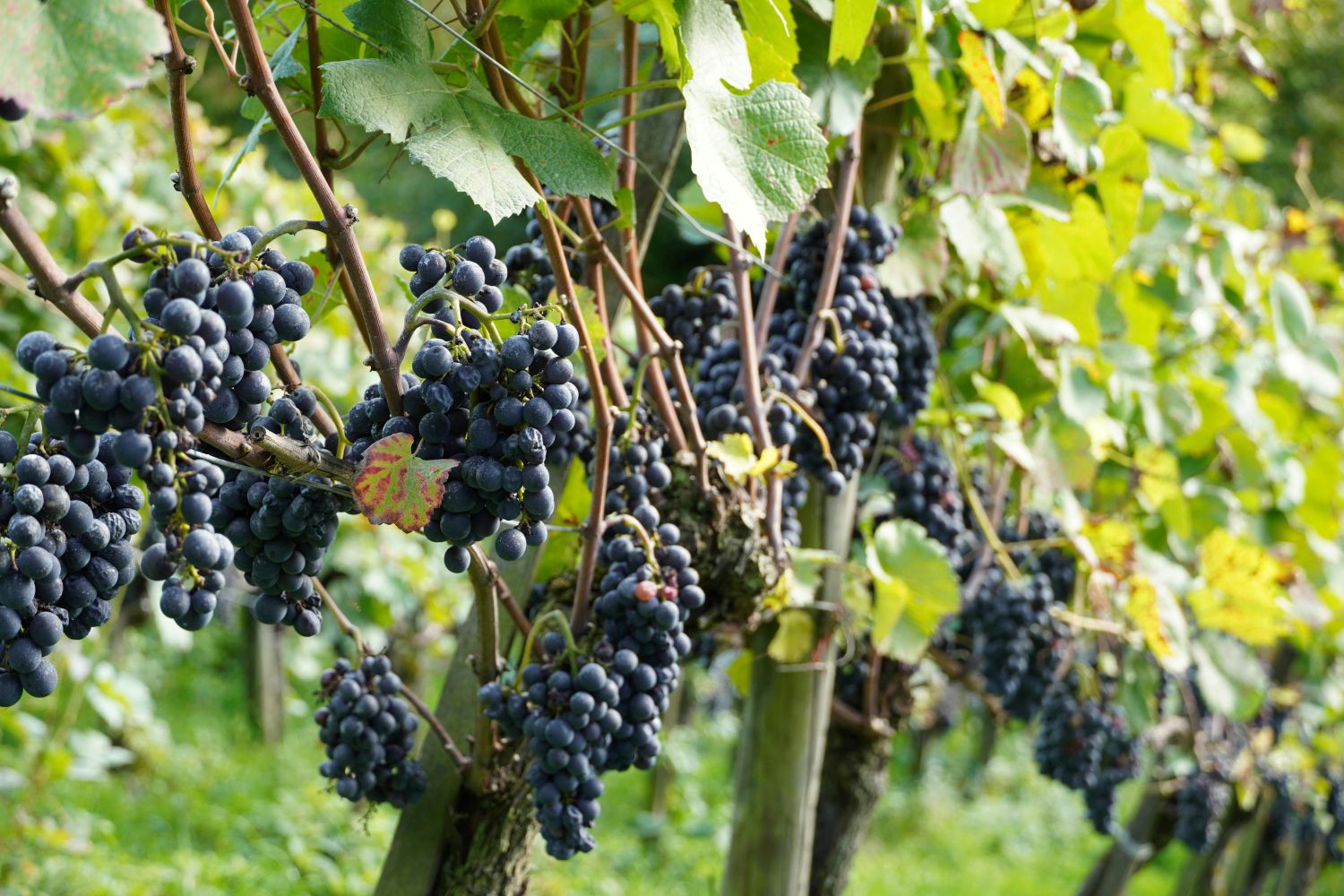
- By late summer, grapes reach véraison and start to ripen in earnest
- Main challenge: Cool, wet weather during June flowering, which can stop flowers from pollinating well and lower how much fruit the vine carries
Jargon explained: véraison
The point when grapes change colour and stop growing bigger, and start building sugar instead. It marks the start of ripening, usually six to eight weeks before harvest.
Once véraison begins, natural acidity drops as sugar levels climb. The process usually takes 30 to 70 days to reach full ripeness (Wine Folly).
In the winery:
- Sparkling wines already in the cellar are disgorged and labelled
- Tanks and barrels are cleaned out ready for the coming harvest
For a closer look at a real English summer in the vineyard, read our post on how warmer weather is affecting English vineyards or see harvest prep in action.
What Happens in an English Vineyard During Harvest?
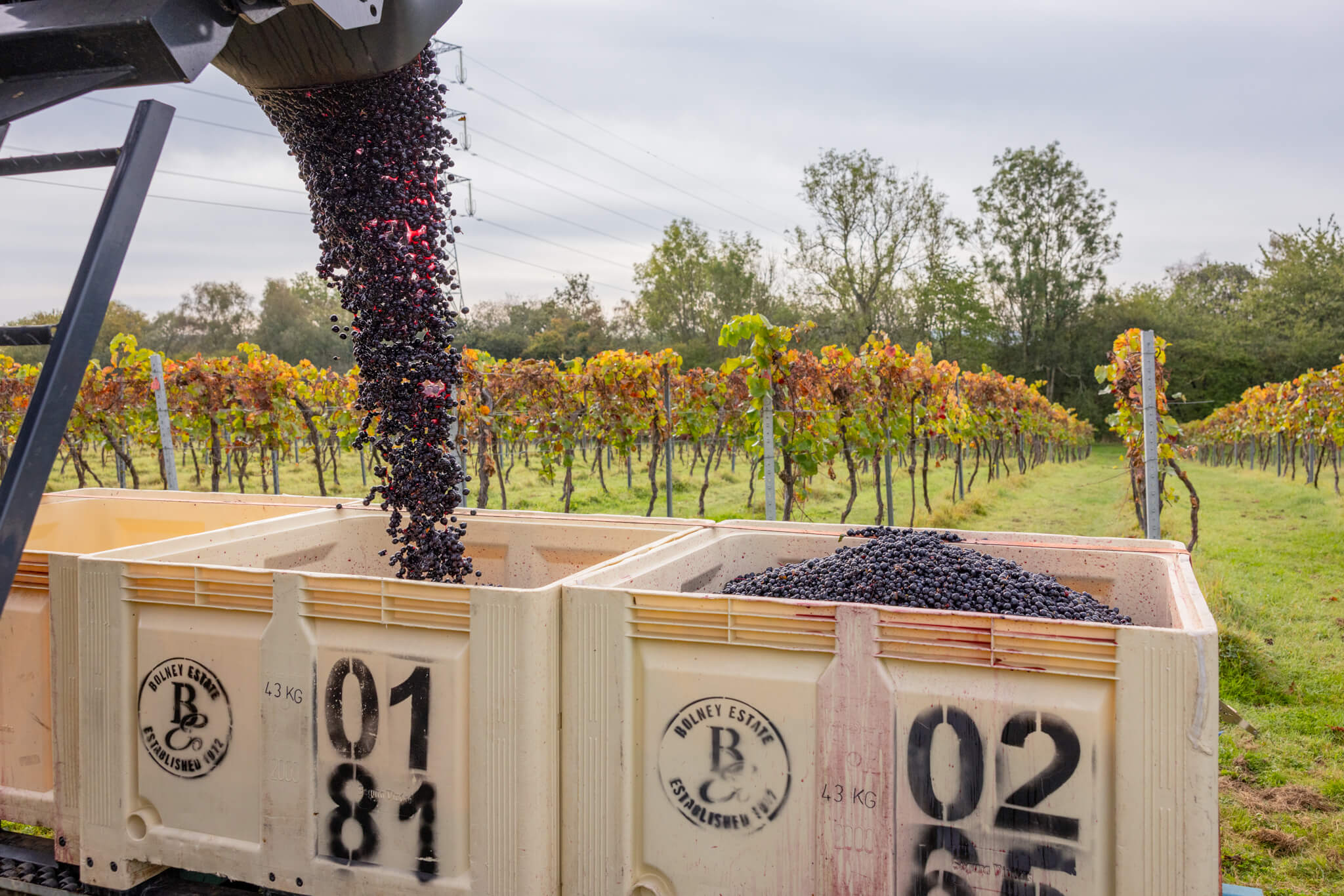
Harvest is when the vineyard’s whole year comes together. Grapes are picked once they reach the right balance of sugar and acid, then pressed to begin winemaking.
In the vineyard:
- Most English vineyards pick from mid-September to mid-October
- Some grapes are hand-picked, especially for traditional method sparkling wine, and others are machine-harvested
- Different grape varieties ripen at different speeds, so picking happens in stages rather than all at once
- Main challenge: Picking at the right moment, since early grapes stay underripe and late grapes risk rain, rot, or an early frost
In the winery: when does winemaking start?
Winemaking begins the moment grapes are pressed. Fresh juice starts fermenting into wine within days of arriving at the winery, as yeast converts sugar into alcohol (Encyclopaedia Britannica). That first fermentation usually runs through autumn and into winter. For the sparkling wine, the base then goes through a second fermentation later on.
For a full walkthrough of an English harvest, see our guide to English wine harvest.
What Happens in an English Vineyard in Winter?
Winter looks like the quietest time in the vineyard, but the vineyard team is busy shaping next year’s crop while the vine itself rests.
Jargon explained: dormancy
The resting phase a vine enters once its leaves drop in autumn. Growth pauses above ground, but the vine holds energy reserves in its roots ready for spring.
In the vineyard:
- The previous year’s canes are pruned back, and new canes are chosen to carry next year’s buds
- Trellis wires and posts are repaired ahead of the new season
- Soil health and drainage are reviewed across the vineyard
- Main challenge: Pruning decisions, since the number of buds left on each vine decides how much fruit it carries the following year (Growing Produce, 2022)
In the winery:
- This year’s wines continue fermenting or resting in tank and barrel
- Sparkling wine base is blended and moved into bottle for its second fermentation
Curious what a working vineyard looks like in the colder months? Our guides to an English vineyard in winter and visiting a vineyard in winter cover both.
How Does This Cycle Shape the Wine?
A cool, slow-warming English spring and summer, followed by a careful harvest, is what gives English wine its characteristic freshness and bright acidity.
| Aspect | Cool climate (England) | Warm climate |
|---|---|---|
| Ripening speed | Slow and gradual | Fast |
| Natural acidity | High | Lower |
| Typical wine style | Fresh, light, high-acid | Riper, fuller-bodied |
That bright acidity is a big part of why England has become known for traditional method sparkling wine, a style that needs naturally high acid to balance its second fermentation in the bottle.
Cool-climate regions typically have a growing-season temperature between 13°C and 15°C, equivalent to roughly 850 to 1,389 growing degree days, based on climatologist Dr Gregory V. Jones’ widely used climate classification research (Wine Folly, citing Jones, 2006).
Why Do Vineyards Replant Their Vines?
A vine can produce good fruit for 30 years or more, but it does not last forever. As vines age, yields decline, and the vines become more exposed to virus and disease pressure. Commercial vineyards are typically productive for 30 to 50 years before replanting becomes necessary, according to research published in the American Journal of Oenology and Viticulture (Riffle et al., American Journal of Oenology and Viticulture, 2022).
Grubbing up
The process, known as grubbing up, involves removing old vines so the soil can rest before new ones go in. It also gives a vineyard the chance to choose grape varieties and rootstocks better suited to today’s climate and winemaking goals.
Bolney’s vineyard team began a similar project in autumn 2025. Rows of vines that were reaching the end of their productive life were removed and replanted with varieties better suited to today’s conditions. Projects like this are becoming more common, as England’s oldest commercial vineyards, many planted in the 1970s and 80s, reach the end of their working life.
Want to see what happens to the material once vines are grubbed up, and how new ones go in? Our posts on what happens to old vines when a vineyard is replanted and new vines taking root in spring cover both stages. Our piece on how wine grapes are propagated explains why replanting uses cuttings rather than seeds.
See the Vineyard Year for Yourself
Find out more about budburst and véraison in person on a guided tour and tasting at Bolney Wine Estate in West Sussex.
Frequently Asked Questions
How long does a full vineyard cycle take?
One full cycle, from budburst to harvest and back into dormancy, takes about a year. The vine repeats this every year of its working life, which can run to 30 years or longer.
Is England considered a cool climate wine region?
Yes. England’s growing-season average temperature has stayed above the recognised 13°C cool-climate threshold every year since 1993 (Nesbitt et al., Australian Journal of Grape and Wine Research, 2016).
Why does English harvest happen later than in warmer countries?
England’s cooler climate means grapes take longer to reach full ripeness, so harvest usually falls in September and October rather than August. A particularly warm year, like 2025, can bring picking forward by several weeks.
Do all vines in a vineyard ripen at the same time?
No. Different grape varieties wake up, flower, and ripen at different speeds, so a vineyard growing several varieties will usually pick them in stages.
When does winemaking start each year?
Winemaking starts at harvest, the moment grapes are pressed and the juice begins to ferment. From there, wine is aged, blended, and in some cases put through a second fermentation for sparkling wine, over the following months.
Sources
- Nesbitt et al., Australian Journal of Grape and Wine Research, 2016
- Wine Folly, What Are Cool Climate Wines?, citing Jones, 2006
- WineGB, 2025 Harvest Report, 25 March 2026
- Wine Folly, Véraison: When Grapes Turn Red
- Growing Produce, What Really Happens to Grapevines During the Dormant Season, 22 March 2022
- Encyclopaedia Britannica, Wine: Fermentation, Ageing, Varietals, updated 24 April 2026
- Riffle et al., American Journal of Oenology and Viticulture, October 2022