Account


The Topsoil Test: Why We Buried Four T-Shirts in Our Vineyard
Start exploring

We buried four T-shirts in our new vineyard, and we hope they come back full of holes.
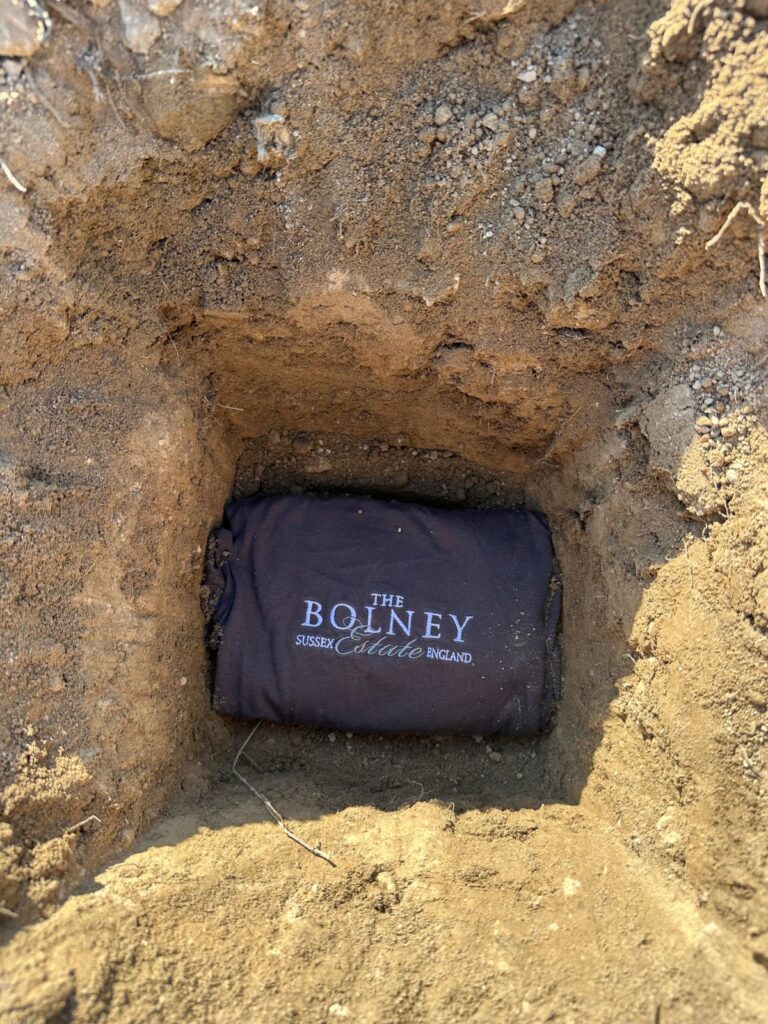
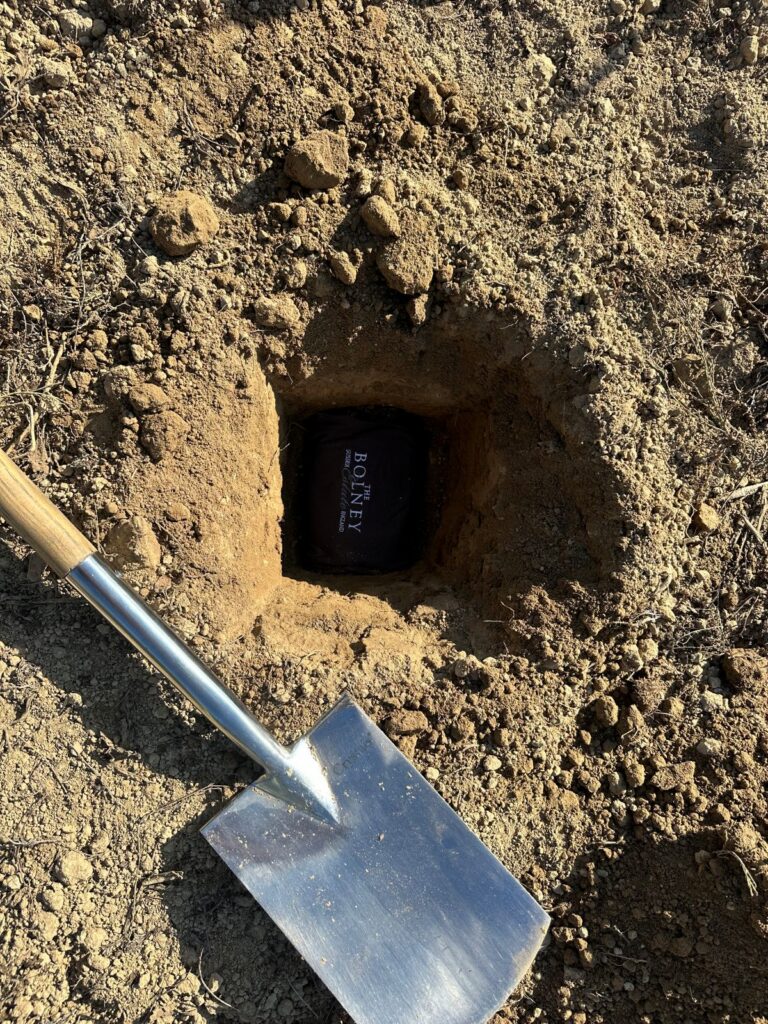
In September 2026, our vineyard team buried four identical cotton T-shirts belonging to our Vineyard Manager, each one 20cm under a different type of plant cover. Over the coming months, soil life will slowly eat away at the cotton. The more of each T-shirt that disappears, the healthier and busier the soil around it.
We’re calling it the Topsoil Test. Here’s the story so far:
The Topsoil Test in brief
- What: Four cotton T-shirts buried 20cm deep
- Where: Our new vineyard, planted in spring 2026
- When: September 2026, just after sowing cover crops
- Why: To find out which plants growing between the vines support the most soil life
Jump to a section
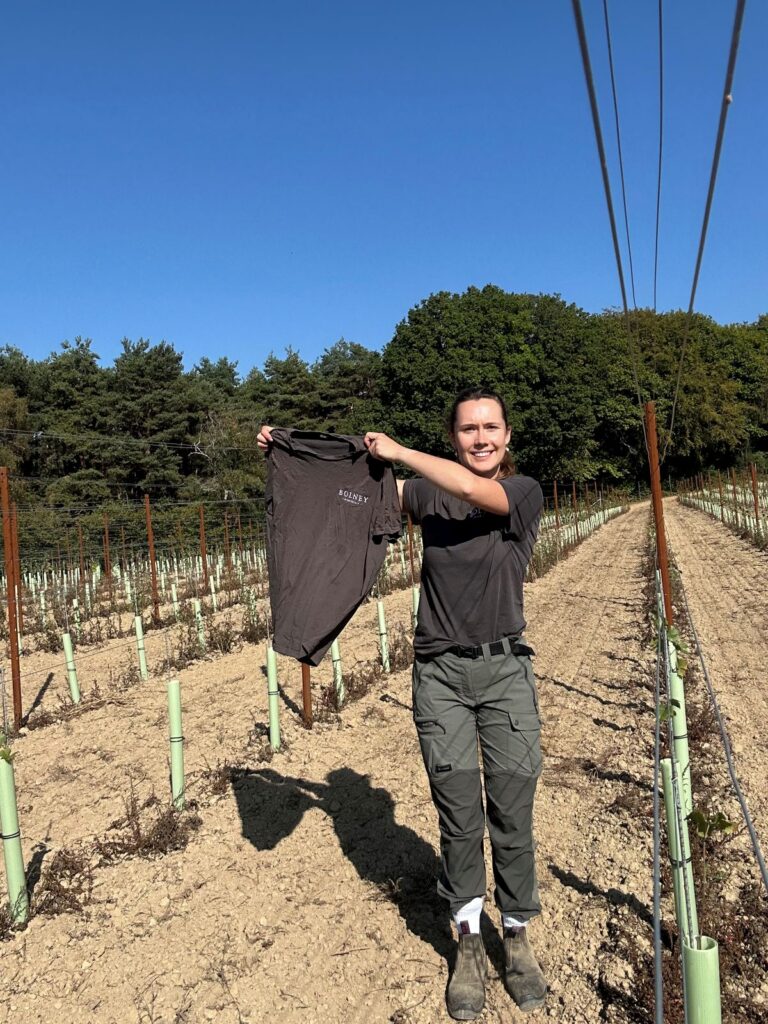
Samantha Ryder, assistant vineyard manager, with a T-shirt to test the soil health at Bolney
What We Buried in the Vineyard, and Why
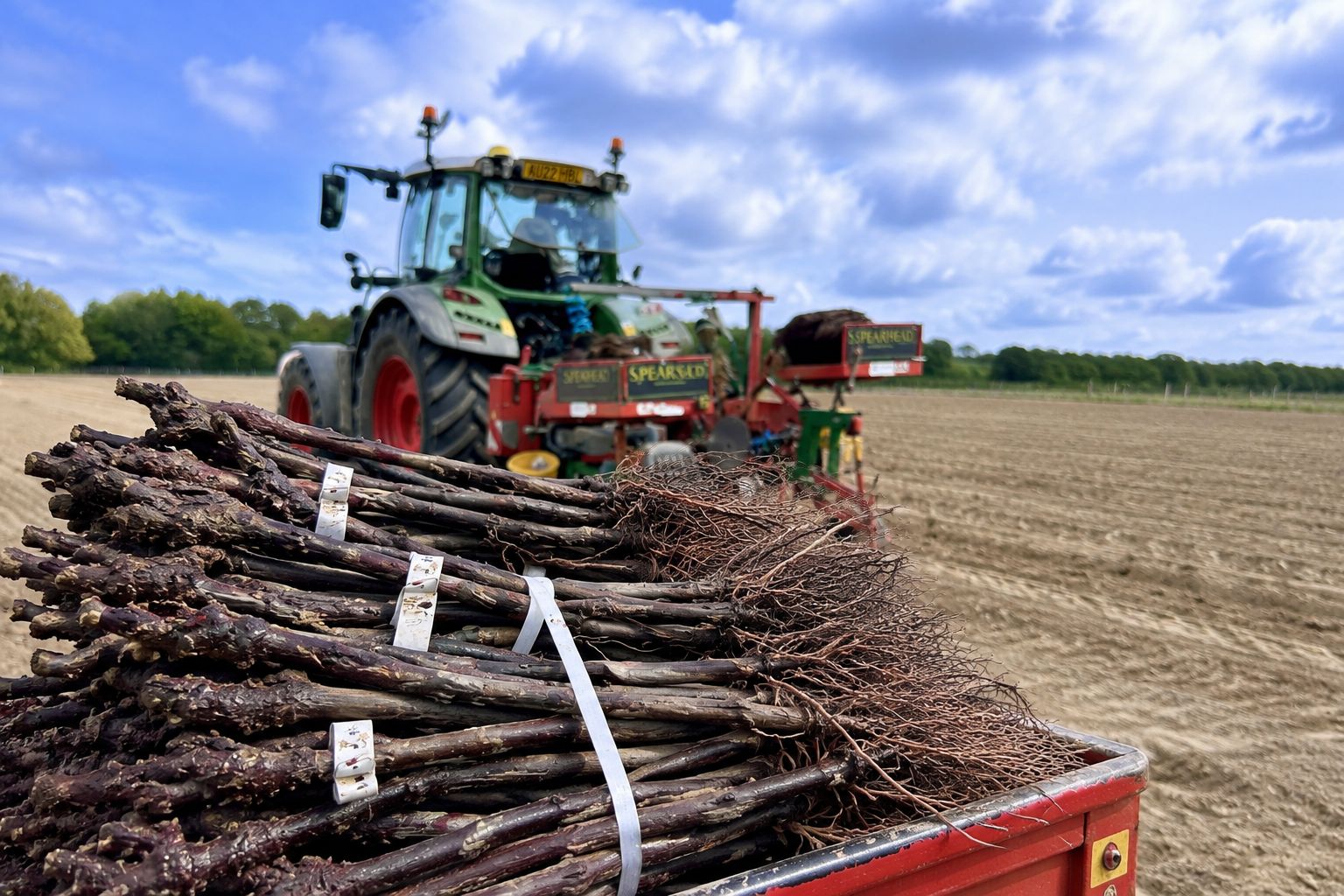
We buried four cotton T-shirts in our youngest vineyard to measure how much life is in the soil under different cover crops. The vines there went in this spring, when 16,000 new vines took root as part of our replanting project.
In September, the team sowed several different cover crop mixes in the rows between those young vines. A few days later, we pulled out the spades.
Jargon explained: cover crop
Plants sown in a vineyard to protect and feed the soil, not to harvest. They keep the ground covered and give soil life a steady supply of food.
Why test the soil at all?
Healthy, living soils are critical to vine nutrition, water availability and fruit quality. Bacteria, fungi and worms break down plant material, release nutrients in forms vine roots can absorb and help bind the soil into crumbs that let water soak in (Horticulturae, 2024). UK plant science organisation NIAB notes that “poor soil health can give rise to inconsistent yields and juice quality”. Soil is also a big part of terroir, the mix of natural conditions that shapes a wine.
Cover crops are one of the main ways growers support that soil life. In a three-year study in a California vineyard, cover crops nearly doubled microbial life between the rows and tripled it under the vines, compared with unplanted ground (Environmental Microbiome, 2025). Closer to home, 91% of respondents to WineGB’s 2024 Sustainability Impact Report said they prioritise sustainable vineyard floor management, which includes cover crops (WineGB).
The question for us is which cover crop works best in our soil. Lab tests can measure soil life, but a buried T-shirt lets everyone see the answer with their own eyes.
Where Did the Soil Your Undies Test Come From?
The soil your undies test is a simple soil health check, promoted for years by soil scientists and farm advisers. New Zealand viticulturist Nick Paulin brought it into the vineyard to compare cover crops, and his work inspired our Topsoil Test.
Inspired by New Zealand
Nick Paulin used buried underwear to compare vineyard cover crops. He found “markedly greater decomposition of cotton undies buried in diverse cover crop blocks versus simple grass”, as New Zealand Winegrowers reported.
Jargon explained: viticulturist
Someone who grows grapes for wine. Viticulture is the farming side of winemaking, from planting vines to picking the fruit.
His test reflects growing interest in regenerative viticulture across New Zealand. He manages organic vineyards for a group of New Zealand wine estates and uses the undies test as a teaching tool, showing growers what’s happening below ground in a way anyone can see.
Jargon explained: regenerative viticulture
Growing grapes in a way that aims to rebuild soil health and wildlife over time, often using cover crops, grazing animals and fewer chemical inputs.
A 2025 feature from New Zealand Winegrowers shows how the movement is taking shape:
- Small trials first: The Regenerative Viticulture Foundation’s “One Block Challenge” invites growers to try regenerative methods on a single block of vines for one year and record the results
- Measuring the soil: Some estates track the organic content of their soil and count earthworms to see if things are improving
- No official label yet: There’s currently no body in New Zealand that certifies vineyards as regenerative
How the test works
The test uses buried cotton as a visual measure of soil life. You bury 100% cotton fabric, wait at least two months, then dig it up. The more it has rotted away, the more active the soil.
Here’s how soil experts describe it:
- In the US: The Natural Resources Conservation Service runs a Soil Your Undies Challenge, asking farmers and gardeners to bury new cotton underwear for at least 60 days
- In science: The University of Tennessee calls it a version of the classic “cotton strip test” researchers use to measure how well soil breaks things down
- Depth: Guides suggest anywhere from about 8cm to 20cm, according to the NRCS and Oregon State University
Why does cotton rot in the soil?
Cotton is food for soil life. Once cleaned and processed, cotton is about 99% cellulose, according to Cotton Incorporated. Soil microbes feed on cellulose every day as fallen leaves and old roots break down.
Jargon explained: cellulose
The main building block of plant cell walls. It gives stems and leaves their strength.
A buried T-shirt is like a plate of food left out for whatever lives in the soil. A busy, varied community will eat through it fast. A quiet soil leaves it mostly whole.
Jargon explained: soil microbes
Living things in the soil too small to see, mostly bacteria and fungi. Healthy soil contains billions of them, according to the NRCS.
Taking the idea one step further
Paulin’s result showed that a mix of many plants fed the soil better than grass alone. Research backs up the link between plant variety and soil life. A 2024 review in Horticulturae highlights a German vineyard study that found soil bacteria diversity increased with the number of plant species.
We wanted to go one step further. Instead of comparing a mix with grass, we’re looking at which plant types make the difference.
The Four Rows We’re Comparing
We buried one T-shirt in each of four vineyard rows. Each row has a different type of ground cover growing between the vines, so we can compare them side by side.
| Row | What’s growing there | What we want to find out |
|---|---|---|
| Row 1: Legumes only | Plants from the pea and bean family | Do legumes alone boost soil life? |
| Row 2: Grasses and wildflowers | A mix with no legumes in it | Does plant variety help without legumes? |
| Row 3: Legumes, grasses and wildflowers | The most varied mix of all | Do the two groups work better together? |
| Row 4: Bare earth | Nothing | How fast does cotton rot with no plants at all? |
Why test legumes separately?
Legumes add nitrogen to the soil, something most other plants can’t do. Small lumps on their roots, called nodules, house bacteria that turn nitrogen from the air into plant food. According to AHDB, legumes can add anywhere from 15 to 325kg of nitrogen per hectare each year, depending on the species.
Jargon explained: legume
A plant from the pea and bean family, such as clover or vetch. Legumes can take nitrogen from the air and add it to the soil.
Why mix legumes with other plants?
Grasses and wildflowers bring different roots and different food for soil life, so a mix may do more than either group alone. A 2024 study by Villat and Nicholas in Frontiers in Sustainable Food Systems found that on farmland, a legume grown with a non-legume stored more carbon in the soil on average than either one alone. The authors say the sample was small and the effect is still unknown for vineyards. Row 3 is our small, hands-on way to explore that.
Why leave one row bare?
The bare earth row is our control. It shows how fast cotton breaks down without any plants, so we can see how much difference each cover crop makes.
Jargon explained: control
In an experiment, the control is the version left unchanged, so there’s something fair to compare everything else against.
What Happens Next
The T-shirts will stay underground while the cover crops settle in. Then we’ll dig all four up, lay them side by side and compare how much of each is left.
Patience will help. We sowed our cover crops in September, and AHDB notes that very little nitrogen fixation happens over winter. The legume rows may only show their full effect once the soil warms up in spring, which is a busy time across the vineyard year.
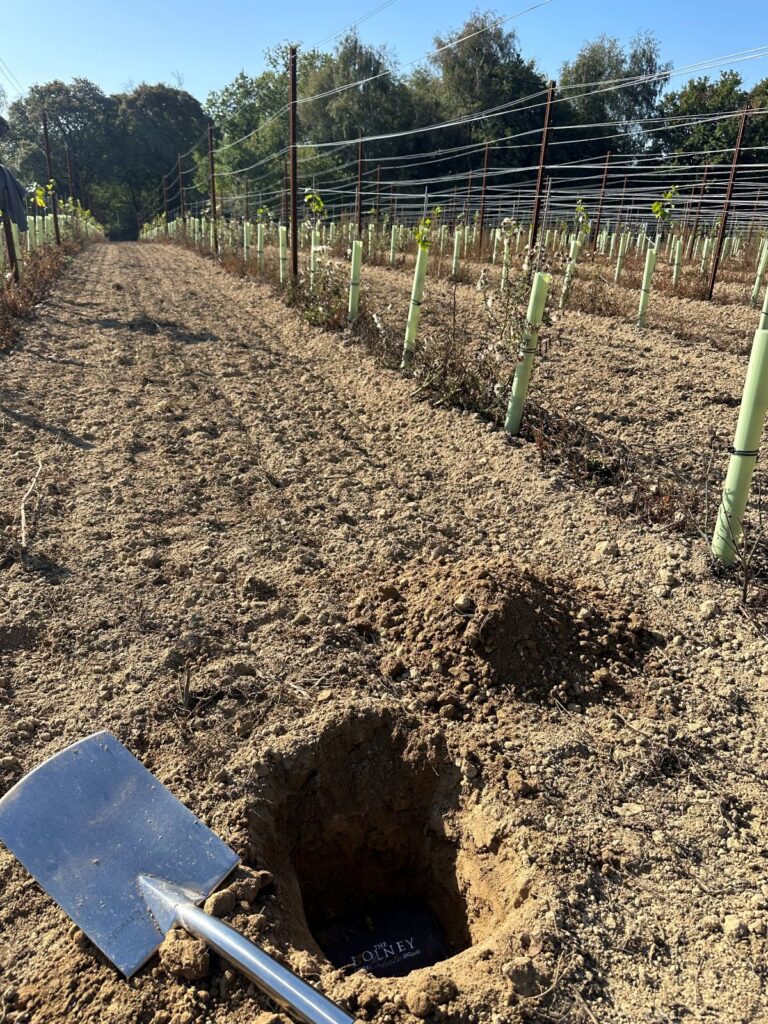
We’ll share the photos and what we learn here on the blog. Fingers crossed for plenty of holes.
See the Vineyard for Yourself
Curious to see how a vineyard is cared for, from the soil up? Join a tour and tasting at Bolney Wine Estate in West Sussex.
Frequently Asked Questions
Can I do the soil your undies test in my garden?
Yes. Bury a pair of 100% cotton underwear or a cotton T-shirt flat, 8 to 20cm deep, and mark the spot. Dig it up after at least two months. Try two spots, such as a lawn and a vegetable bed, to compare them.
Why does the fabric need to be 100% cotton?
Cotton is almost pure cellulose, which soil life can eat. Synthetic fabrics such as polyester don’t break down in soil in the same way, so they won’t show you anything. Expect elastic waistbands to survive.
How long should cotton stay buried for a soil test?
At least 60 days, according to the US Natural Resources Conservation Service. Soil life slows down in cold weather, so a winter test may need longer to show a clear result.
What does a healthy soil test result look like?
Lots of holes, thin patches or very little fabric left. The more the cotton has broken down, the more active the soil life. Fabric that comes up almost whole suggests the soil could do with more life.
Sources
- USDA Natural Resources Conservation Service: Soil Your Undies Challenge: Test method, 60-day burial, billions of soil microbes
- University of Tennessee Institute of Agriculture: Soil Your Undies! How Healthy is Your Soil?: Link to the cotton strip test
- Oregon State University Extension: Test Your Soil Health by Burying a Pair of Briefs: Burial depth, watering, reading the results
- Cotton Incorporated: Cotton Morphology and Chemistry: Processed cotton is 99% cellulose
- New Zealand Winegrowers: Regenerative Viticulture: Nick Paulin’s undies test, the One Block Challenge and regenerative viticulture in New Zealand
- Visconti, López and Olego (2024), The Health of Vineyard Soils: Towards a Sustainable Viticulture, Horticulturae: Soil life, nutrients and soil structure, plant variety and soil bacteria in vineyards
- Rocha and others (2025), Environmental Microbiome: Cover crops and soil microbial life in a vineyard
- Villat and Nicholas (2024), Frontiers in Sustainable Food Systems: Legume and non-legume cover crop pairings and soil carbon
- AHDB: Biological Fixation of Nitrogen by Rhizobia: How legumes fix nitrogen, amounts fixed, low winter fixation
- WineGB: Sustainability: 2024 Sustainability Impact Report figures on vineyard floor management
- NIAB: Viticulture and Oenology Research: Soil health, yields and juice quality