Account


Office Christmas Party Wine: How Much to Buy Per Person
Start exploring

Half a bottle of wine per guest is enough for most work events, from the welcome toast to the final farewells. Over a long lunch or dinner, that’s three 125ml glasses per person.
Start with these figures for each drinking guest:
Wine per drinking guest (125ml glasses)
- Drinks reception (1 to 2 hours): Two glasses, or about a third of a bottle
- Seated lunch or dinner (2 to 3 hours): Three glasses, or about half a bottle
- Evening party (4 hours or more): Four glasses, or about two-thirds of a bottle
If you’re organising a work event or the office Christmas party, use this guide to work out how many bottles you need for 20 to 100 guests, the best mix of fizz, white and red, and how to make guests who skip alcohol feel just as welcome.
Jump to a section
How Much Wine Per Person Should You Plan for a Work Event?
Half a bottle of wine per drinking guest is a reliable figure for a work lunch or dinner. Wine Spectator’s long-running advice column suggests guests have two to three drinks each at a dinner or drinks party, which comes to around half a bottle per person when wine is the only drink on offer.
Work events tend to sit at the lower end of that range. People are with colleagues, many are driving or catching a train, and the event often happens on a weekday.
How to calculate
To work out your total wine order, you need to consider:
- Drinking guests: The number of people who will drink alcohol
- Glasses each: Two, three or four, depending on the length of the event
- Glasses per bottle: Six, if you pour 125ml glasses
Then follow three quick steps:
- Step 1: Multiply the number of drinking guests by the glasses each. That gives you the total number of glasses
- Step 2: Divide the total glasses by six. That gives you the number of bottles
- Step 3: Add around 10% and round up, so you don’t run short before the speeches
For example, 30 guests having three glasses each need 90 glasses. That’s 15 bottles, or 17 bottles once you add the extra 10%.
How many glasses are in a bottle of wine?
A standard 750ml bottle of wine gives six 125ml glasses, five 150ml glasses or just over four 175ml glasses. In the UK, still wine sold by the glass comes in 125ml and 175ml measures, or multiples of those, so most guests will expect those sizes. Our guide to how many glasses are in a bottle of wine goes into more detail.
Jargon explained: pour
A pour is the amount of wine served in one glass. At events, a 125ml pour is the easiest to plan around and keeps the pace gentle.
Pour size changes your order more than anything else. If staff pour 175ml glasses instead of 125ml, you need about 40% more wine for the same number of glasses.
How Many Bottles of Wine Do You Need for 20, 50 or 100 Guests?
For a seated meal with 50 drinking guests, you need about 25 bottles of wine, or 28 with a 10% buffer. The table below shows bottle counts for common group sizes, based on 125ml glasses and before any buffer is added.
| Number of drinking guests | Drinks reception (2 glasses each) | Seated lunch or dinner (3 glasses each) | Evening party (4 glasses each) |
|---|---|---|---|
| 20 drinking guests | 7 bottles | 10 bottles | 14 bottles |
| 40 drinking guests | 14 bottles | 20 bottles | 27 bottles |
| 50 drinking guests | 17 bottles | 25 bottles | 34 bottles |
| 60 drinking guests | 20 bottles | 30 bottles | 40 bottles |
| 100 drinking guests | 34 bottles | 50 bottles | 67 bottles |
What makes people drink more or less?
A few things change how much wine your guests will drink. Order a little more or a little less if your event has any of these:
- Time of day: Lunchtime events need less wine than evening ones. Many guests are going back to work or have a journey home
- Food: People drink more slowly when they sit down to a meal. With only canapés, glasses empty faster, so allow a little extra
- Length: Guests drink the most in the first hour, then slow down. A four-hour party needs more wine than a two-hour one, but not twice as much
- Who pours: When staff top up glasses at the table, more wine gets poured than when guests go to the bar themselves
- The season: Christmas parties tend to run longer and feel more festive, so plan towards the higher figures
Jargon explained: magnum
A magnum is a 1.5 litre bottle, the same as two standard bottles. For big groups, magnums mean fewer bottles to open and look generous on the table. Our guide to why you might choose a magnum explains more.
What Mix of Sparkling, White and Red Wine Should You Order?
For a work Christmas lunch or dinner, a good split is one glass of sparkling wine per guest on arrival, then still wine divided roughly evenly between white and red. In winter, nudge the balance slightly toward red, as it suits richer seasonal food.
A glass of sparkling wine is a lovely way to welcome guests. It gives everyone something to hold as they say hello, and it’s already in hand when the toast comes round.
English wine suits a British celebration, and there’s plenty to choose from. England and Wales produced more than 10.6 million bottles of wine in 2024, according to WineGB figures reported by The Drinks Business.
Jargon explained: brut
Brut is the label for a dry sparkling wine, and it is the most popular style. Read more in our guide to brut, extra dry and demi-sec.
A worked example: a Christmas lunch for 50
Here’s an example of the wine order for a three-hour team Christmas lunch for 50 people. In this example, 40 guests drink wine, and 10 prefer alcohol-free drinks. Each drinking guest has three 125ml glasses: one sparkling, then two still.
| Wine | When it is served | Glasses | Bottles |
|---|---|---|---|
| Sparkling | On arrival and for the toast | 40 | 7 |
| White | Starter and fish or poultry | 40 | 7 |
| Red | Main course and cheese | 40 | 7 |
| Buffer (about 10%) | Split between white and red | 12 | 2 |
| Total | Across the whole lunch | 132 | 23 |
For help matching each wine to the menu, our sparkling wine guide and red wine guide both include food pairings.
How Many Guests Won’t Be Drinking Alcohol?
The easiest way to find out how many guests will drink is to ask on the RSVP. If you cannot ask, assume a fair share of your team will choose alcohol-free or low-alcohol drinks for at least part of the event.
The trend is clear. Drinkaware research from October 2025 found that 44% of UK adults now use no or low-alcohol drinks to cut down, up from 31% in 2018. Among young adults, the figure rose from 28% to 49%.
What to offer guests who skip the wine
- Something sparkling: An alcohol-free fizz or a good sparkling juice, so everyone can join the toast
- Something grown-up: A non-alcoholic wine or a crafted soft drink, served in a wine glass
- Plenty of water: Still and sparkling water on every table, all event long
Plan for three to four soft drinks per non-drinking guest over a three-hour event. Serving them in the same glassware as the wine means nobody stands out.
How Does Wine Fit Into Your Christmas Party Budget?
Wine is part of your event’s cost per head, so plan it alongside food and venue hire. HMRC treats an annual staff party as tax-free for employees when it is open to all staff and costs £150 or less per person. Our guide on how to plan a corporate Christmas party covers budgets, dates and venues in full.
Good to know: drinks packages
Venues usually charge for wine either per bottle opened or as a set package per head. Ask which one applies, as it changes how closely you need to count.
Planning Your Team’s Christmas Party?
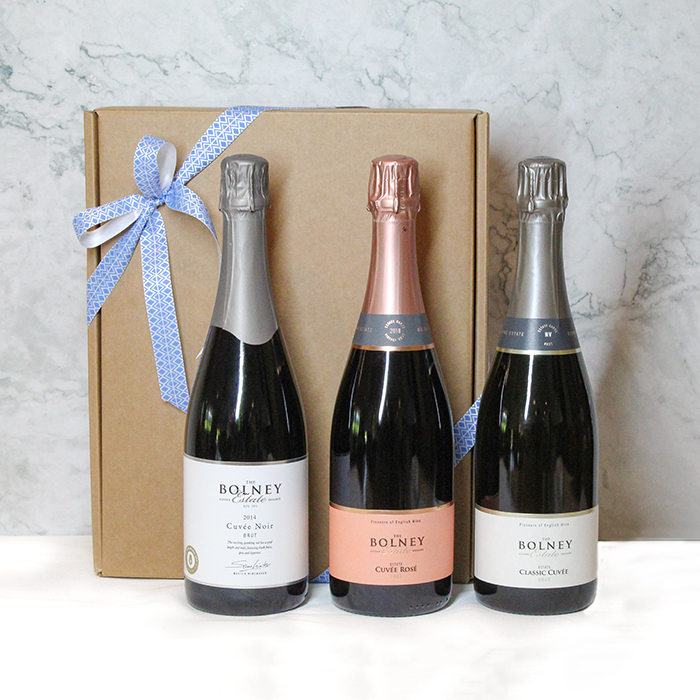
Bolney Wine Estate has been growing grapes in West Sussex since 1972. Our events team can help you plan the food, wine, and numbers for a relaxed corporate Christmas party at the vineyard.
Frequently Asked Questions
How many bottles of wine do I need for 50 people?
For a seated lunch or dinner where all 50 guests drink wine, you need about 25 bottles. Add a 10% buffer and order 28 bottles. For a short drinks reception, around 17 bottles is enough.
How many glasses of wine are in one bottle?
A standard 750ml bottle of wine gives six 125ml glasses, five 150ml glasses or just over four 175ml glasses.
How much sparkling wine do I need for a toast?
Allow one 125ml glass of sparkling wine per guest for a toast, which means one bottle serves six people. A toast for 100 guests needs about 17 bottles.
Is half a bottle of wine per person too much for a work event?
Half a bottle per drinking guest is a planning figure for a two- to three-hour meal, not a target for each person. Many guests will drink less, and the leftover bottles cover those who drink a little more.
Should I offer alcohol-free wine at a work party?
Yes. Many people now choose no- or low-alcohol drinks, so offering alcohol-free sparkling or still wine means everyone can join the toast and feel included.
Sources
- Wine Spectator: How much wine and Champagne should I buy for my holiday party?: Two to three drinks per guest, about half a bottle per person
- GOV.UK: Weights and measures, specified quantities: 125ml and 175ml measures for still wine by the glass
- The Drinks Business: English wine sales climb 3%: WineGB figures showing England and Wales produced more than 10.6 million bottles of wine in 2024
- Drinkaware: Half of young adults are now choosing no and low-alcohol drinks: 44% of UK adults and 49% of young adults use no or low-alcohol drinks to moderate
- GOV.UK: Expenses and benefits, social functions and parties: The £150 per head annual party exemption