Account






How Many Millilitres Is a Bottle of Wine?
Start exploring

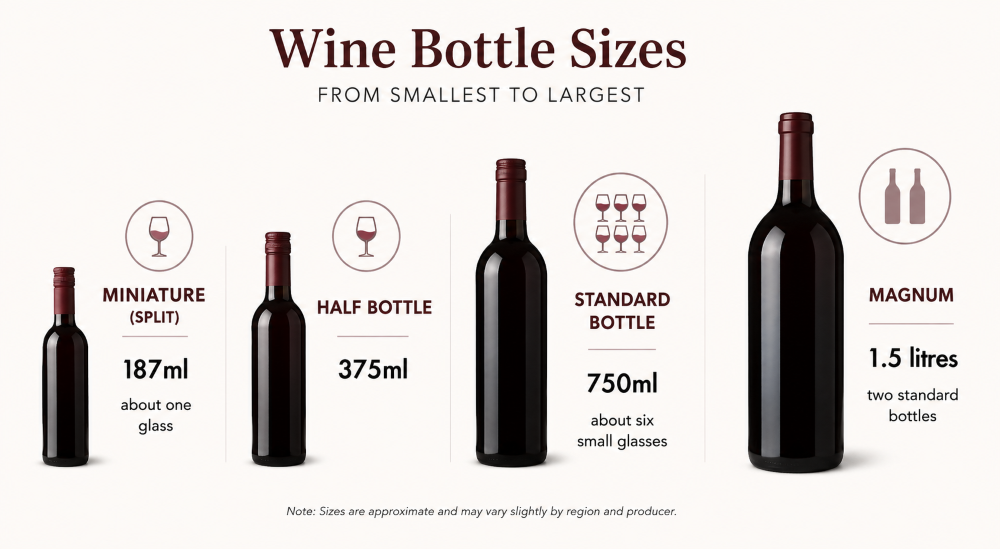
A standard bottle of wine holds 750 millilitres (ml). That is 75 centilitres, or three-quarters of a litre, and in the UK it fills about six small 125ml glasses. Almost every red, white, rosé and still bottle you pick up will be this size.
Wine comes in plenty of other sizes too, from single-serve miniatures to giant bottles named after ancient kings. Here are the ones you will meet most often.
Common wine bottle sizes
- Standard bottle: 750ml (about six small glasses)
- Half bottle: 375ml
- Magnum: 1.5 litres (two standard bottles)
- Miniature (split): 187ml (about one glass)
Below you will find each size, why 750ml became the norm, and how the UK compares with Europe, the US, and Australia.
Jump to a section
How Many Millilitres Is a Standard Bottle of Wine?
A standard bottle of wine holds 750ml. In older imperial measures, that works out at about 26.4 UK fluid ounces, or 25.4 US fluid ounces, according to the reference figures for a wine bottle. The volume is printed on every wine label, so you can always check it yourself.
From one 750ml bottle you get roughly:
- Six 125ml glasses
- Four to five larger 175ml pours
The 750ml size is used for white, red and rosé alike. It is also the standard for most sparkling wine. A sparkling bottle looks heavier because the glass is thicker to hold the pressure of the bubbles, but it still contains the same 750ml.
For more detail, see how many glasses of wine are in a bottle and how many units are in a bottle of wine.
Why Is a Wine Bottle 750ml?
A wine bottle is 750ml because of trade history, not because of any rule about how much one person should drink. The size settled during the 1800s and simply stuck.
One popular story says early bottles were mouth-blown, and 750ml was about as much as a glassblower could shape in a single breath. It is a charming tale, but the more practical reason was the wine trade between France and England, as glass suppliers such as Saverglass explain in their bottle-size history.
Large cases of wine bottles:
- A case of 12 bottles: 12 x 750ml is 9 litres, which was close to two imperial gallons.
- A Bordeaux barrel: a 225-litre barrel divides evenly into 300 bottles of 750ml.
Those round numbers made shipping and duties easier to calculate. Later packaging rules across Europe locked 750ml in as a set size, and it remains a legal size for selling wine in the UK today.
What Are the Main Wine Bottle Sizes?
Everyday wine bottle sizes range from a single-serve miniature at 187ml to a magnum at 1.5 litres. The 750ml standard sits in the middle and is by far the most common.
Jargon explained: split (or piccolo)
A split, also called a piccolo, is a small single-serve bottle holding about 187ml. It is the size often served on planes and at events, giving one glass without opening a full bottle.
| Wine Bottle Size | Millilitres | Also known as | Rough serving |
|---|---|---|---|
| Miniature | 187ml (also 200ml) | Split, piccolo | About one glass |
| Half bottle | 375ml | Demi | About three glasses |
| Standard | 750ml | Bottle | About six glasses |
| Litre | 1,000ml | Litre | About eight glasses |
| Magnum | 1,500ml | Two bottles | About twelve glasses |
Wine fact: the UK’s set bottle sizes
In the UK, packaged wine can only be sold in fixed volumes. For still wine these are 100, 187, 200, 250, 375, 500, 568, 750, 1,000 and 1,500ml, as listed in the government’s weights and measures guidance.
What Are the Big Wine Bottle Sizes Called?
Once a bottle is bigger than a magnum, it takes on a grand name, mostly borrowed from kings in the Bible. These large formats are used for celebrations, ageing fine wine and collecting.
Jargon explained: magnum
A magnum holds 1.5 litres, the same as two standard bottles. It is the most common large format and the easiest to find in shops. You can browse English wine magnums to see the size in real life.
| Large Wine Bottle | Volume | Standard bottles |
|---|---|---|
| Magnum | 1.5 litres | 2 |
| Jeroboam | 3 litres | 4 |
| Rehoboam | 4.5 litres | 6 |
| Methuselah (Imperial) | 6 litres | 8 |
| Salmanazar | 9 litres | 12 (a full case) |
| Balthazar | 12 litres | 16 |
| Nebuchadnezzar | 15 litres | 20 |
Names aren’t fixed across every region. As Decanter’s guide to bottle sizes points out, a 3-litre bottle is a Jeroboam in Champagne and Burgundy, but Bordeaux calls the same size a double magnum and saves the Jeroboam name for a larger bottle.
Large formats are prized for more than show. With less air in contact with the wine relative to its volume, wine in bigger bottles tends to age more slowly and evenly, which is why collectors seek them out.
Are Wine Bottles the Same Size Everywhere?
Yes, for the most part. The 750ml bottle is the shared standard for still wine across the UK, Europe, the US, and Australia, which makes trading wine between countries straightforward. A few local details are worth knowing.
The UK
Alongside 750ml, the UK now allows more choice. Since September 2024, still and sparkling wine can also be sold in 200ml and 500ml sizes and in a new 568ml “pint” bottle, following changes set out in the government’s guidance on prepacked wine quantities.
The United States
The US moved to 750ml as its main size in 1979. Before that, the common bottle was a “fifth”, meaning one fifth of a US gallon, which came to about 757ml. The switch to metric rounded it down to a neat 750ml, as covered by the US Alcohol and Tobacco Tax and Trade Bureau.
Europe and Australia
Across the EU and in Australia, 750ml is again the standard wine bottle.
Which Wine Bottle Size Should You Choose?
Pick the size to suit the moment: a miniature for one glass, a standard bottle for two people over dinner, and a magnum when there is a crowd. Here is a quick way to decide.
For one glass: a miniature
Best for: trying a new wine, travel, small gifts
An 187ml or 200ml bottle pours a single glass without opening a larger bottle. Single-serve options like a 20cl sparkling bottle are handy for picnics and gifting.
For dinner for two: a standard or half bottle
Best for: a meal at home, a quiet evening
A 750ml standard bottle suits two people comfortably. If you want less, a 375ml half bottle gives about three glasses and lets you try more than one wine in a sitting.
For a celebration: a magnum
Best for: parties, big gatherings, generous gifts
A magnum holds two bottles’ worth and makes a fine centrepiece. It also ages well, so it is a thoughtful choice for a birth year or anniversary.
Stocking a range of sizes is one of the easiest ways to be ready for dinners and celebrations big or small. Our guide to setting up a home wine bar covers what to keep in, and once the bottle is open, the right wine glass makes a real difference, including the best glasses for sparkling wine.
Taste the difference for yourself
The best way to understand wine is to taste it where it is made. Come and learn more at our working vineyard and winery in West Sussex.
Frequently Asked Questions
How many ml is a standard glass of wine?
In UK pubs and restaurants, still wine is served in 125ml or 175ml glasses. A 750ml bottle therefore gives about six small glasses or four to five larger ones.
How many millilitres is a half bottle of wine?
A half bottle, sometimes called a demi, holds 375ml. That is half of a standard 750ml bottle, or roughly three glasses.
How big is a magnum of wine?
A magnum holds 1.5 litres (1,500ml), the same as two standard bottles. It is the most widely available large format.
What is the smallest bottle of wine?
The smallest common bottle is a miniature or split, holding about 187ml to 200ml. It pours a single glass and is often served on planes and at events.
Is a wine bottle 750ml everywhere?
For still wine, yes. The 750ml bottle is the standard across the UK, EU, US and Australia. The UK now also allows 200ml, 500ml and 568ml sizes alongside it.